Postdoctoral Researcher · Department of Chemistry · UT Austin
Saptarsi Mondal

I use two-dimensional infrared spectroscopy to measure how hydrogen-bond networks and ion solvation shells rearrange at electrified and confined interfaces — on the femtosecond-to-picosecond timescales that decide catalysis, ion transport and light–matter coupling.
Peer-reviewed articles
28
Research settings
4
India, Japan, South Korea, United States
Journal cover selections
2
Current position since
Nov 2024
Selected publications
34 records → all publicationsFeatured projects
research programme →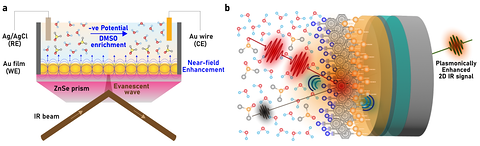
■ Interfacial & electrochemical dynamics
Cosolvent and potential control of interfacial water
I am establishing cosolvent composition as a second control variable, alongside applied potential, for the structure and dynamics of water at an electrode surface, and measuring both with surface-specific vibrational spectroscopy.
More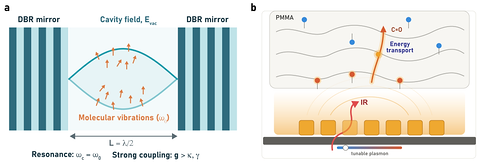
■ Polaritonic & plasmonic control
Tunable plasmonic metasurfaces for vibrational coupling
I use self-assembled doped-oxide nanocrystal metasurfaces, tunable across the mid-infrared, as an open alternative to high-Q microcavities for coupling light to molecular vibrations, and broadband 2D IR to measure what that coupling does to molecular dynamics.
MoreAcademic journey
full academic journey →-
2024–present current
The University of Texas at Austin · United States
-
2023–2024
University of Michigan · United States
-
2019–2023
Korea University · South Korea
-
2013–2018
Indian Association for the Cultivation of Science · India
Recognition & service
all awards & recognition →-
Best Poster Award in Photochemistry
-
Journal cover selection, Journal of Physical Chemistry Letters
-
Front cover selection, Journal of Physical Chemistry A


Reviewer for Angewandte Chemie and The Journal of Chemical Physics . Peer review & service →