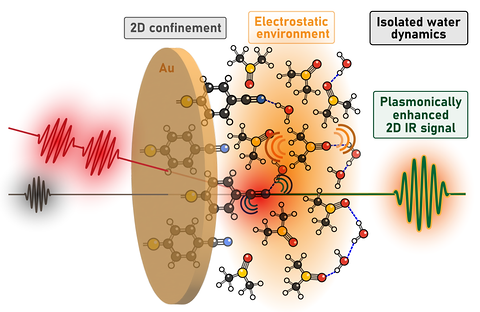
Schematic of surface-enhanced 2D IR at a gold surface. Infrared pump and probe pulses reach a gold disc bearing tethered nitrile probe molecules; beyond it, water and DMSO molecules are shown hydrogen bonded to one another. Labels mark two-dimensional confinement, the electrostatic environment, isolated water dynamics, and the plasmonically enhanced 2D IR signal that emerges.
Surface-enhanced 2D IR isolates hydrogen-bond rearrangement within a few nanometres of the electrode, where confinement and the interfacial electric field both act on the probe.

■ THEME I · CURRENT · 4 PAPERS

Interfacial and electrochemical dynamics

How does the hydrogen-bond network of water rearrange in the few nanometres next to an electrode, and how does applied potential — or an added cosolvent — change it?

Operando SEIRAS resolves interfacial structure under applied potential; surface-enhanced 2D IR resolves the picosecond dynamics of the same species. Bulk 2D IR on identical probes is the reference, and constant-potential molecular dynamics ties the spectra to solvation statistics.

Read the theme

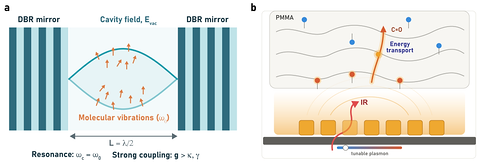
Two-panel schematic. On the left, a Fabry–Perot cavity formed by two distributed Bragg reflector mirrors separated by half a wavelength, with the vacuum cavity field drawn between them and molecular vibrations represented as arrows; the strong-coupling condition is written beneath. On the right, a PMMA film above an array of indium tin oxide nanocrystal blocks, with an infrared wave entering from below and an arrow marking vibrational energy transport through the polymer along the carbonyl mode.
Two routes to coupling a molecular vibration to a confined optical mode: a closed high-Q Fabry–Perot cavity, and an open-faced, continuously tunable plasmonic metasurface.

■ THEME II · CURRENT · 1 PAPERS

Polaritonic and plasmonic control of molecular behaviour

Can hybridising a molecular vibration with a confined optical mode measurably change how a molecule moves and reacts — and if so, under what conditions does the effect reproduce?

Fabry–Pérot microcavities cover the high-Q regime where most reported VSC chemistry has been done. Plasmonic metasurfaces — including self-assembled doped-oxide nanocrystal films — give an open, broadly tunable alternative with very large local fields. Broadband, polarisation-controlled 2D IR is the dynamical readout in both.

Read the theme

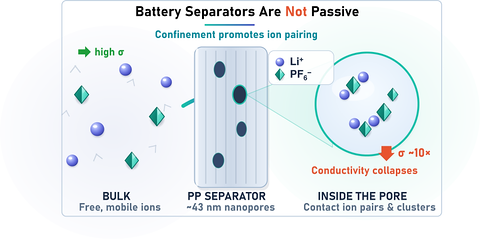
Three-panel comparison titled "Battery separators are not passive". On the left, bulk electrolyte with free, mobile lithium ions and hexafluorophosphate anions shown separately and labelled high conductivity. In the centre, a polypropylene separator with roughly 43 nanometre nanopores. On the right, a magnified view inside a pore where the same ions have associated into contact ion pairs and clusters, with an arrow marking an approximately tenfold collapse in conductivity.
The same electrolyte behaves differently inside the separator: nanoconfinement promotes contact ion pairing and clustering, and conductivity falls sharply.

■ THEME III · ONGOING · 3 PAPERS

Electrolytes, confinement and ion transport

How does an ion shed its solvation shell to cross an interface, and what does the porous separator — long treated as an inert spacer — actually do to ion solvation and transport?

Native carbonate carbonyl and anion stretches as vibrational reporters, with embedded nitrile probes where extra sensitivity is needed. Bulk speciation and dynamics by FTIR, two-dimensional correlation spectroscopy and polarisation-resolved IR pump–probe; interfacial dynamics by surface-enhanced 2D IR using transparent conductive plasmonic electrodes. Quantum-chemical calculation assigns the marker bands, and electrochemical impedance spectroscopy connects molecular speciation to macroscopic transport.

Read the theme

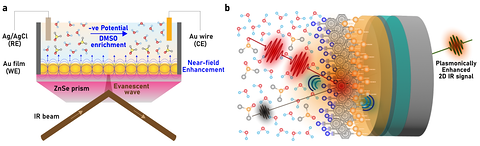
Two-panel schematic of the surface-sensitive techniques. On the left, a SEIRAS spectro-electrochemical cell in which an infrared beam enters a zinc selenide prism and produces an evanescent wave enhanced at a gold film working electrode, with reference and counter electrodes and an arrow marking DMSO enrichment under negative potential. On the right, the surface-enhanced 2D IR geometry in which pump and probe pulses interact with gold-tethered nitrile probe molecules and a plasmonically enhanced signal emerges.
The two surface-specific methods that underpin the interfacial work: SEIRAS for potential-resolved structure, surface-enhanced 2D IR for picosecond dynamics.

■ THEME IV · ONGOING · 6 PAPERS

Vibrational probes, methods and analysis

What is a vibrational probe actually reporting, and how do we extract a trustworthy dynamical number from a noisy, congested, overlapping spectrum?

Isotope substitution to disentangle overlapping bands, 2D IR to expose couplings invisible in the linear spectrum, reformulated analytical models fitted against molecular dynamics, discrete wavelet transform denoising to raise signal-to-noise, and machine-learned interatomic potentials to make the computational half tractable.

Read the theme

■ THEME V · COMPLETED · 20 PAPERS

Weak noncovalent interactions and functional materials

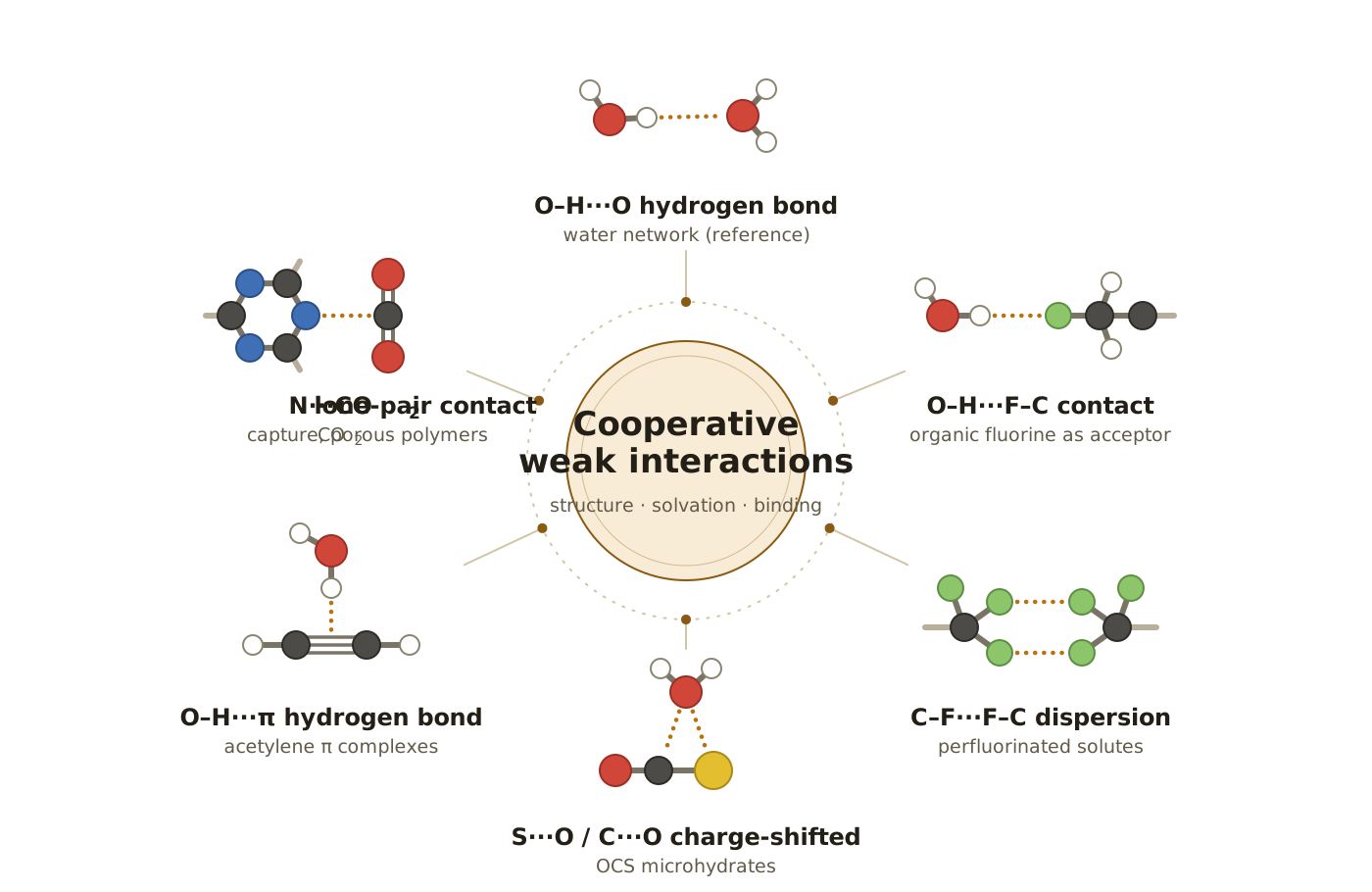
When an interaction is too weak to be a conventional hydrogen bond, does it still organise a liquid — and can that organisation be measured rather than inferred?

A consistent four-part method: infrared spectroscopy of the bulk liquid to see the network, molecular dynamics simulation to see the structure producing it, quantum-chemical calculation to get energies, and atoms-in-molecules topological analysis to establish whether a contact is a genuine bond path rather than a coincidence of geometry. Fluorescence upconversion and time-correlated single-photon counting supply the dynamics.

Read the theme

Projects

Individual projects

Each project page states the scientific motivation, the specific question, the methods, my own contribution, the results so far and the intended next step — and names collaborators where the work was shared.

Interfaces

Cosolvent and potential control of interfacial water

Establishing cosolvent composition as a second, orthogonal handle — alongside applied potential — on the structure and dynamics of water at an electrode surface, and measuring both with surface-specific vibrational spectroscopy.

Current work Collaborative

Electrolytes

Battery separators as active regulators of ion transport

Testing whether the porous separator in a lithium-ion cell — normally treated as an inert spacer — changes the chemistry of the electrolyte inside it, using vibrational spectroscopy to resolve ion speciation under nanoconfinement.

Ongoing Collaborative

Polaritons

Tunable plasmonic metasurfaces for vibrational coupling

Using self-assembled doped-oxide nanocrystal metasurfaces, tunable across the mid-infrared, as an open-faced alternative to high-Q microcavities for coupling light to molecular vibrations — and using broadband 2D IR to measure what that coupling does to molecular dynamics.

Current work Collaborative

Probes & methods

Water structure and free volume in biocompatible polymers

Two connected questions about amorphous polymers: what water does at their surface, and how large the empty spaces inside them actually are — both answered by ultrafast infrared measurement rather than by inference from bulk properties.

Completed Collaborative